Knowledge Graphs: how a semantic layer becomes usable context
Turn Semantic Definitions Into Traceable AI Context for Accurate, Auditable Answers

Extending the concept of Semantics we discussed in the previous post, and building on the ecosystem effect: Semantic Layer + Knowledge Graph.
If the semantic layer is the dictionary of Finance, a knowledge graph is the map. One defines the meaning of “Net Revenue.”
The other connects Net Revenue to the real world it depends on: customers, contracts, invoices, entities, policies, exceptions, and the systems that produced the numbers.
That connection is what turns GenAI from “well-worded” into correct, traceable, and reusable.
So, what is a Knowledge Graph (in Finance terms)?
A knowledge graph is a governed network of:
Entities (nodes): Customer, Legal Entity, Contract, Invoice, Payment, GL Account, Product, Policy, Close Task
Relationships (edges): belongs_to, recognized_under, maps_to, paid_by, reconciles_with, approved_by, derived_from
It’s not just “metadata.” It’s how your ecosystem hangs together—in a form an AI system can traverse.
Why it matters
RAG alone retrieves documents.
A knowledge graph retrieves the right context path.
So instead of dumping a giant context window into an LLM, you can ask:
“Which invoices are eligible candidates for this payment?”
“Which entity owns the contract?”
“Which policy governs the treatment?”
“What changed since last close?”
That is enterprise-grade context: targeted, explainable, and cheap.
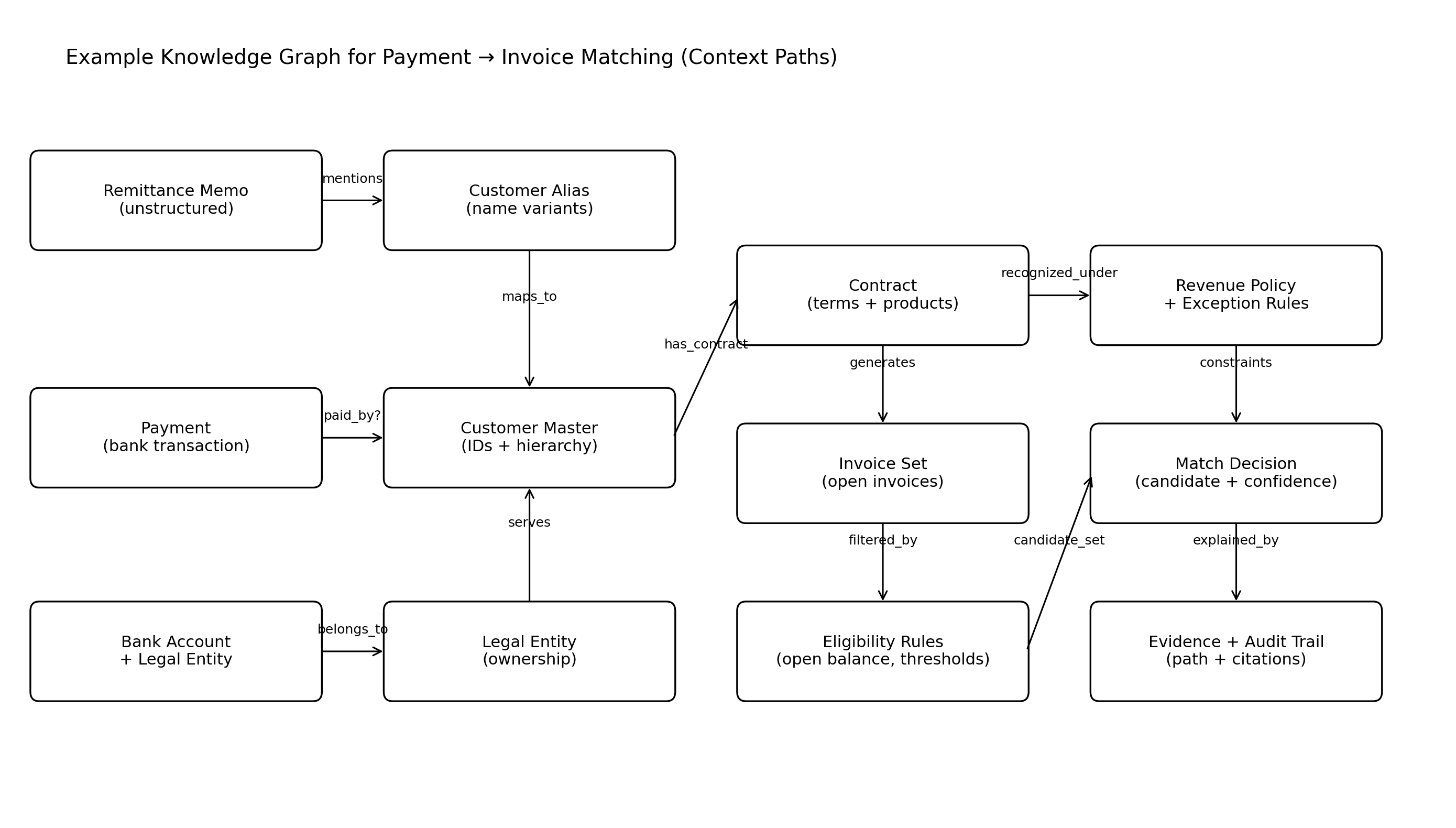
Use case from the trenches: Payment → Invoice matching
In payment-to-invoice matching, the hard part isn’t “finding text similarity.”
It’s the messy reality:
parent/child customer hierarchies
name aliases (“ACME Inc” vs “ACME Holdings”)
partial payments across multiple invoices
FX, fees, timing gaps
multiple source systems disagreeing on “customer”
A knowledge graph makes matching operationally sane:
Traverse: Payment → Bank Account → Legal Entity → Customer Set → Open Invoices
Use the semantic layer for governed definitions: “open balance,” “invoice eligibility,” “materiality thresholds”
Let the LLM do what it’s best at: interpreting unstructured remittance notes and drafting rationale
Output an auditor-friendly explanation: “Matched because path A→B→C with evidence X; exception rule Y applied.”
You don’t just get a match. You get a match you can defend.
To summarize:
Semantic layer = one language
Knowledge graph = connected reality
Together = context the AI can reliably use across close, reconciliations, variance commentary, policy Q&A, and controls
It’s also how you reduce AI cost without sacrificing accuracy:
Retrieve the smallest relevant context path, not the largest possible blob of text.
If you want AI in Finance to be production-grade, don’t just teach it definitions.
Teach it how your enterprise connects through Knowledge Graphs.
Where do you see the biggest “context gap” today in your organizations, and how have you applied these concepts in practice?